remediation
MHCLG adds Easy read, BSL and translated guidance to remediation Code page
The housing ministry has added an Easy read document, a British Sign Language version of its Plain English guide and four translations to the Code of Practice that every cladding remediation project in England is expected to follow.
The Ministry of Housing, Communities and Local Government (MHCLG) has added an Easy read document, a British Sign Language version of its Plain English guide and four translations of the guide to the GOV.UK page for the cladding remediation Code of Practice.
The department published the new formats on 2 November 2026 on the page for the Code of Practice for the remediation of residential buildings. The translations of the Plain English guide are in Bangla, Polish, Romanian and Spanish, each an 11-page PDF.
The Easy read document is a 21-page PDF titled "Rules for doing work to help fix homes". The British Sign Language version of the Plain English guide is a video.
The Plain English guide itself was added to the page on 12 December 2025. MHCLG says the guide should be used with the full Code and does not replace it, and that anyone fixing unsafe cladding on buildings should follow the full Code.
What the Code requires
The Code was first published on 27 July 2023 and applies in England. MHCLG describes it as putting residents at the heart of remediation and making clear what they can expect during a project. The department says all remediation projects should comply with it.
The Code is guidance rather than law, but the government says every project is expected to follow it. Requirement 4.1 says projects should be able to demonstrate compliance, and MHCLG says it will look to ensure projects are compliant and take action if necessary.
The resident factsheet, updated on 1 May 2025, says the Code applies to every remediation project regardless of who is responsible for delivering it or how it is funded.
The Code focuses on works required to mitigate fire safety risks caused by an external wall system, and projects are expected to comply from inception through to completion, when works are signed off by an authorised person.
According to the Plain English guide and the factsheet, residents should be able to meet those responsible for a project before work starts, receive regular, clear and up-to-date information about progress and any changes, and know how to raise questions or complaints. Residents should also be told they can report health and safety problems to the Health and Safety Executive.
Where buildings need covering, the factsheet says netting, mesh and transparent coverings should be used, and residents should be told how long scaffolding will be up.
MHCLG says the Code was developed with residents, freeholders, developers, construction companies, landlords, agents and government and industry organisations.
The acceleration plan
The government's Remediation Acceleration Plan refers to driving compliance with the Code of Practice. The Code itself notes that the country's largest developers have agreed to fix their own buildings.
The plan aims for all 18m+ buildings with unsafe cladding in a government funded scheme to have been remediated by the end of 2029, and for every 11m+ building with unsafe cladding to have been remediated or have a completion date by the same point.
The remediation programme
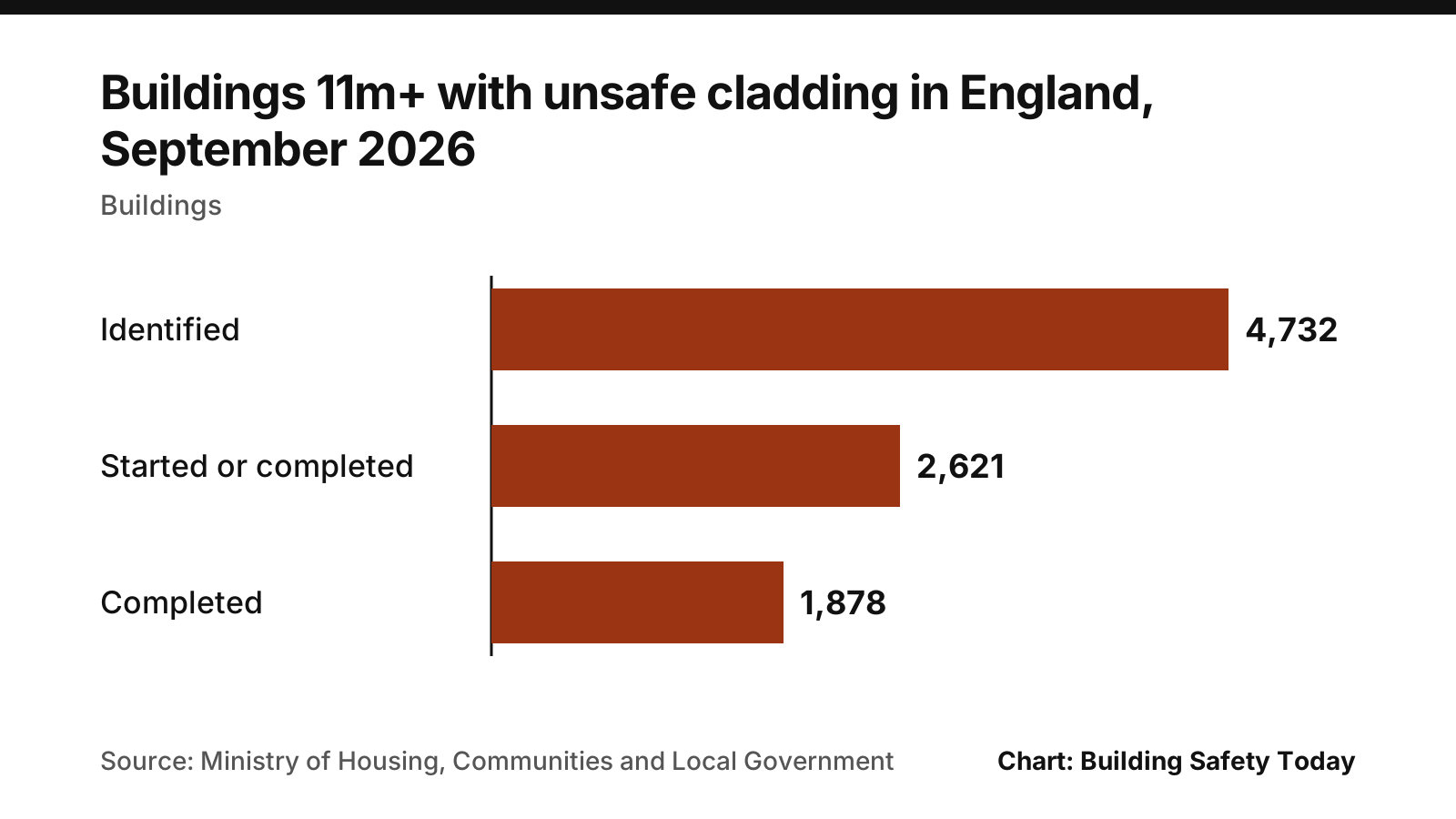
MHCLG's September 2026 monthly data release identified 4,732 residential buildings 11 metres and over in England with unsafe cladding. Of those, 2,621 (55%) had started or completed remediation works and 1,878 (40%) had completed them.
| Buildings 11m+ with unsafe cladding, England | Number |
|---|---|
| Identified | 4,732 |
| Started or completed works | 2,621 |
| Completed works | 1,878 |
The department estimates there are between 5,900 and 7,400 residential buildings 11 metres and over in England, and that remediating residential buildings will cost between £11.8bn and £22.7bn.
The next monthly remediation data release is due at 9.30am on Wednesday 25 November 2026.
On the record: Ministry of Housing, Communities and Local Government
Sources
- Ministry of Housing, Communities and Local Government (GOV.UK) (opens in a new tab) (accessed 2026-11-02)
- Ministry of Housing, Communities and Local Government (GOV.UK) (opens in a new tab) (accessed 2026-11-02)
- Ministry of Housing, Communities and Local Government (GOV.UK) (opens in a new tab) (accessed 2026-11-02)
- Ministry of Housing, Communities and Local Government (GOV.UK) (opens in a new tab) (accessed 2026-11-02)
- Ministry of Housing, Communities and Local Government (GOV.UK) (opens in a new tab) (accessed 2026-11-02)
- Ministry of Housing, Communities and Local Government (GOV.UK) (opens in a new tab) (accessed 2026-11-02)
This story was researched from the primary sources above and checked against them before publication. Spotted an error? Tell us and we will correct it promptly.