Grenfell
Nine in 10 construction leaders say a Grenfell-scale fire could happen again, IOSH survey finds
IOSH's Safe by design white paper, based on a survey of 250 senior leaders, reports that 91% think another Grenfell-scale tragedy is possible and 51% see specifications changed mainly to cut cost.
More than nine in 10 senior UK construction leaders believe a tragedy on the scale of Grenfell Tower could happen again, according to research commissioned by the Institution of Occupational Safety and Health (IOSH) and published on 25 November 2026.
The findings appear in an IOSH white paper, Safe by design, which the body said raises concerns about accountability, competence, procurement practices and risk management across the built environment.
The survey covered 250 senior industry figures, including chief executives, managing directors and site directors. IOSH said 91% of them believe another Grenfell-scale tragedy could happen in the UK.
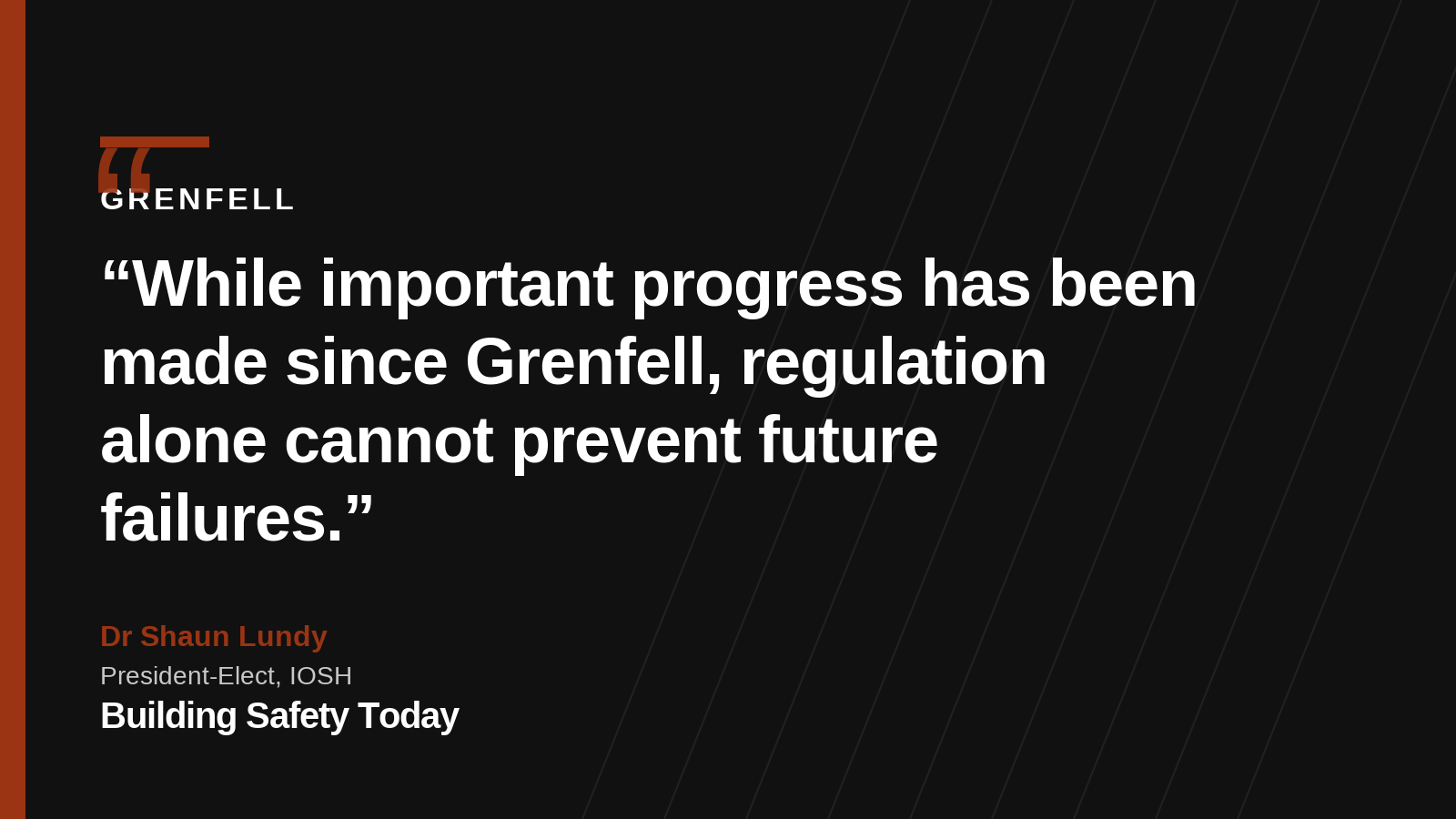
Dr Shaun Lundy, President-Elect of IOSH, said: "While important progress has been made since Grenfell, regulation alone cannot prevent future failures."
The findings
Alongside the headline figure, IOSH reported that 81% of leaders believe between 10% and 50% of construction risks could have been eliminated through better design decisions before work started.
Just over half, 51%, said materials, products and specifications are often or always changed primarily to reduce project costs. The white paper warns that commercial pressures continue to influence critical decisions throughout projects, IOSH said.
At the same time, 93% of respondents said they were confident their own organisation has the competence needed to manage health and safety risks across the building lifecycle. Asked about the sector's biggest skills gap, 31% pointed to supply chain management and contractor competence.
Stronger leadership accountability was named by 34% as the change that would have the greatest impact on improving safety outcomes.
The call for a lifecycle approach
IOSH is using the paper to call on government, industry leaders and built environment professionals to adopt a lifecycle approach to safety and health. It argues that health and safety should be treated as a whole-system issue spanning planning, design, procurement, construction, occupation, maintenance, refurbishment and decommissioning.
Lundy said: "The greatest opportunity to prevent harm is often before construction starts, when decisions about design, procurement, competence and governance are still being made."
The body's recommendations include embedding safety-in-design principles and whole-life risk management, and reforming procurement to prioritise safety, quality and long-term value alongside cost. It also calls for better collection and sharing of health and safety information and more support for occupational health and worker wellbeing.
The paper identifies climate change, extreme temperatures, skills shortages, evolving technologies and workforce retention as emerging challenges for the sector.
IOSH said the Building Safety Act, introduced in 2022, has led to improvements but that more needs to be done. The position is consistent with its response to the Grenfell Tower Inquiry final report in September 2024, when it said fire safety must be actioned throughout a building's lifecycle, starting at the planning and design stage.
The regulatory backdrop
The research arrives while the post-Grenfell regime is still being put in place. The inquiry's Phase 2 report, led by Sir Martin Moore-Bick, was published on 4 September 2024. The government's response records that 72 people died in the fire, 18 of them children.
In that response the Ministry of Housing, Communities and Local Government (MHCLG) said 49 of the inquiry's recommendations were being accepted in full by the government and other responsible organisations, and committed to a single construction regulator delivering the functions set out in the report with two exceptions.
The government's September 2026 progress report said it had completed the full transition of the Building Safety Regulator out of the Health and Safety Executive by transferring staff in June 2026. In January 2026 IOSH had called on the regulator to keep its commitment to high standards during that move.
MHCLG said a further nine recommendations had been completed since its May 2026 progress report. The Construction Products Reform White Paper consultation closed in May 2026, with government responses due later in the year.
IOSH, which was granted its Royal Charter in 2002, has 50,000 members in more than 130 countries.
On the record: Ministry of Housing, Communities and Local Government
Sources
- IOSH (opens in a new tab) (accessed 2026-11-26)
- IOSH (opens in a new tab) (accessed 2026-11-26)
- IOSH (opens in a new tab) (accessed 2026-11-26)
- IOSH (opens in a new tab) (accessed 2026-11-26)
- Ministry of Housing, Communities and Local Government (GOV.UK) (opens in a new tab) (accessed 2026-11-26)
- Ministry of Housing, Communities and Local Government (GOV.UK) (opens in a new tab) (accessed 2026-11-26)
This story was researched from the primary sources above and checked against them before publication. Spotted an error? Tell us and we will correct it promptly.